
Builders waste and rubble removal
Kitchen and bathroom strip outs, plasterboard, timber, bagged rubble, tiles and site clearances. Priced by weight, loaded by us, no permit required.
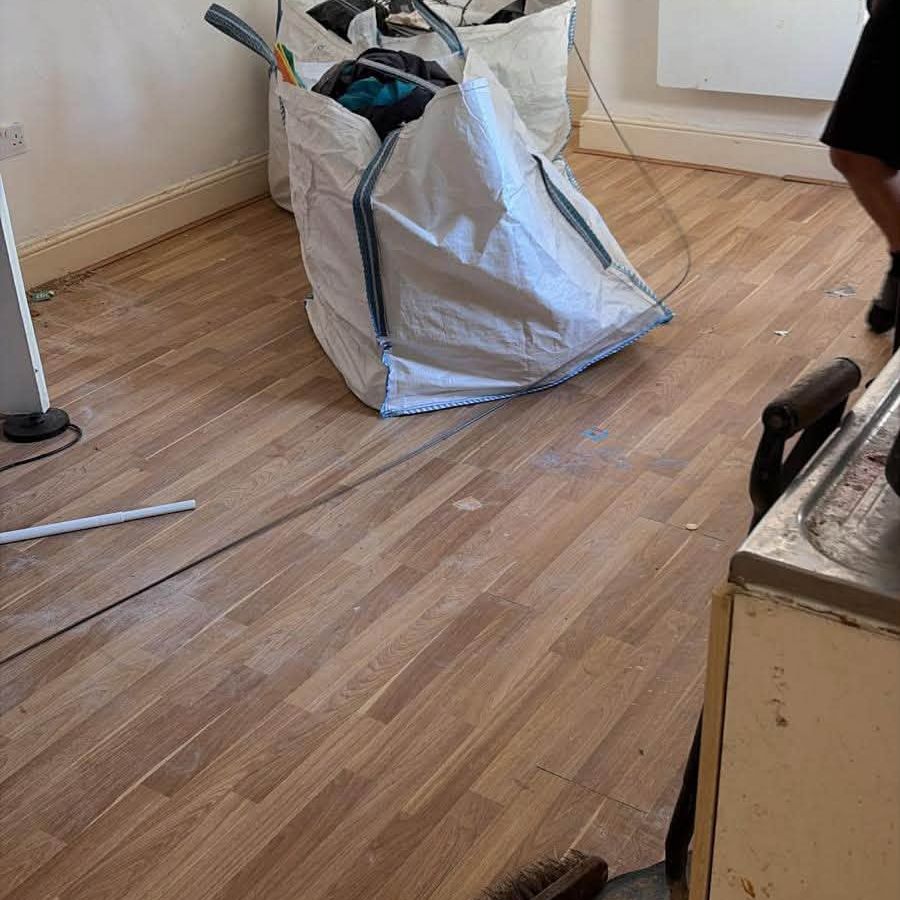

For builders, and for people who have hired one
Half our construction work comes from trades who want a van on site rather than a skip in the road. The other half comes from homeowners whose builder has finished, taken the money, and left a garden full of old kitchen units and a bath.
Either way it is the same job. We load it, we take it, you get a transfer note.
What we take from a site
- Kitchen and bathroom strip out waste, including units, worktops and sanitaryware
- Bagged rubble, hardcore and broken concrete
- Bricks, blocks and broken paving
- Floor and wall tiles
- Timber, skirting, joists and old floorboards
- Plasterboard and plaster, kept separate
- Old radiators, pipework and scrap metal
- Packaging, offcuts and general site rubbish
- Soil and spoil from groundwork
Plasterboard has to be kept separate
Gypsum based waste cannot legally go to landfill mixed with biodegradable waste. When it degrades alongside general rubbish it produces hydrogen sulphide, which is why the rules exist and why transfer stations charge a premium for contaminated loads.
Keep plasterboard in its own pile or its own bags. It costs you less and it takes us less time. Mixed into everything else, the whole load has to be treated as contaminated.
Heavy waste prices by the tonne
This is the part that catches people out. Rubble, soil, concrete and tiles are charged by weight because that is how the transfer station charges us. A Luton van hits its legal weight limit long before it is physically full.
So a "full load" of hedge cuttings and a "full load" of broken concrete are completely different jobs at completely different prices. Anybody quoting you the same figure for both has not thought about it, and will be renegotiating on the day.
Tell us roughly what the mix is and we will price it properly. See how our pricing works.
Why this usually beats a skip
- No permit. A skip on the road in Birmingham needs a council permit and often a parking bay suspension on top. We park, load and go.
- No waiting. A skip has to be delivered, filled by you, then collected. That is days. We are usually in and out inside an hour or two.
- You do not lift anything. With a skip, every single item is your job to carry. That is the part people underestimate.
- Nobody else can fill it. Leave a skip out overnight and half the street contributes. You pay for their rubbish.
- Full comparison of skip hire against a man and van, including when a skip genuinely is the better call.
- You pay for what you use. Half a skip costs the same as a full one. Half a van does not.
The bit most companies never mention
Under the Environmental Protection Act you have a household duty of care for your own waste. In plain English: if you hand your rubbish to somebody who fly tips it, and the council traces it back to you, you get the fixed penalty, not them. Birmingham enforces this and has taken fly tippers to court.
So before you let anyone load a van, ask for two things. Their waste carrier registration number, which you can check free on the Environment Agency register in about thirty seconds. And a waste transfer note for your job, which is the receipt proving where your waste went.
We are a registered waste carrier and we issue a transfer note for every single job, without being asked. If you are a landlord, an agent or a business, keep it. If you are a householder, it is still worth having.
A quick sanity check
If somebody quotes you a price that seems far too good, ask where the waste is going and what the tip fees are. Tipping costs real money. A price that does not cover it usually means the load is going into a lay by somewhere, with your name still on the envelopes inside it.
Builders waste questions
Why is rubble priced differently to everything else?
Because tips charge for it by weight, not by volume. A van can be legally full of rubble long before it is physically full of rubble. We price heavy waste per tonne rather than per load, which is how the whole industry does it and the only honest way to quote it.
Can you take plasterboard?
Yes, but it has to be kept separate. Plasterboard and other gypsum based waste cannot legally be landfilled with general waste because it produces hydrogen sulphide when it degrades. Keep it in its own pile and it is straightforward. Mix it into everything else and the whole load becomes a problem.
Do you clear the site during the job or at the end?
Either. Some builders want a van at the end of the strip out, others want us back twice a week so the site stays workable. If you are running a job in Birmingham and want a regular slot, ring and we will set one up.
Can you invoice a limited company?
Yes. We invoice businesses properly and provide the waste transfer note with it, which you will need for your own records.
Is this cheaper than a skip for a kitchen strip out?
Usually, and definitely quicker. A skip needs a permit if it goes on the road, has to be delivered and collected, and you load it yourself. We load it. For most domestic strip outs a van beats a skip on both cost and time.
Have a look at these too

Skip in the road? Permit? Nah.
We park, we load, we go. Same day where we can.